Tuesday, 31 May 2011

Families find out about food waste

Families with children under five in south Shropshire can find out how to save money and have fun with food this half-term.  To celebrate National Family Week, the Surestarts in South Shropshire are staging special "Love Food Hate Waste" workshops.  The workshops are free and will advise parents and carers on how best to store food to get the most out of it, and help find ways of save up to £50 a month on your grocery bill.


The Love Food Hate Waste sessions have been set up to give parents the knowledge and skills which they can share through fun activities with their children.  The workshops include practical demonstrations, handy hints and tips, recipes, advice on shopping and meal planning, ideas for 'recycling' leftovers, and advice on how to store food to last longer.

Love Food Hate Food Events in south Shropshire will be held on:

Tuesday 31 May 2011
  • Sure Start Children’s Centre, Albrighton school from 1pm to 3pm
  • The Café at The Foyer, Marstons Mill, Portcullis Lane, Ludlow, from 1pm to 3pm 
Wednesday 1 June 2011
  • Highley Severn Centre, Bridgnorth Road,  from 9.30am – 11.30am
  • Sure Start Children’s Centre, St Mary’s Bluecoat CE Primary School, The Grove, Bridgnorth from 1 pm – 3pm
 Thursday 2 June 2011
  • Sure Start Children’s Centre, Bishop’s Castle Primary School, Oak Meadow from 9.30am to 11.30am
  • Sure Start Children’s Centre, Stokesay Primary School, Meadow Street, Craven Arms from 1pm – 3pm
Friday 3 June

  • Broseley Methodist Church, Duke Street from 9.30am 11.30am
Shropshire Councillor Aggie Caesar-Homden, who is responsible for Sure Start centres in the county said:
Our busy lifestyles can often leave us with little time for family life and to shop wisely and prepare fresh food.  So to mark National Family Week I want to encourage parents and carers to take part in these Love Food Hate Waste Workshops.  I hope they will gain lots of useful hints and tips and a great deal of fun from these sessions, and share their experience at home with their children.”
Free crèches will be available at each centre.  For more information about these events and to book a place for you and your child, call 01694 723465

Thursday, 26 May 2011

Sutton Farm Community Cafe

Some volunteers from Shropshire Master Composters have been helping to teach residents around Sutton Farm in Shrewsbury all about home compostingWe took along our display of home composting bins and some compost and worms and gave a talk about the basics of how to compost, and what types of material work best for home composting.   Around 25 people turned up for the talk which went down very well with the enthusiastic audience.


Sutton Farm Community Cafe, is a new initiative, set up by Shropshire Master Composter volunteer Jean Breakwell.  The aim is to help bring residents together for a cuppa, a chat and slice of (yummy!) cake.   It takes place every Thursday afternoon at the St. Giles Church Hall, which is on Sutton Way, Shrewsbury, SY2 6EF

Fair trade tea and home made cakes are available from 1:30pm-4.30pm.  Alot of residents bring along a book or a paper and just like to catch up with each other.  Many of the residents are enthusiastic knitters and so a bit of a knitting circle has formed around it and so rag rug making, knitting and crochet help is available.  Help with transport may be available on request.  For more information ring 01743-360519.

Wednesday, 25 May 2011

New IVC planned for North Shropshire

Shropshire Council 's planning committee has just approved plans by a private firm to install a demonstration “in-vessel” composting (IVC) unit at a disused aircraft hangar on Peplow Airfield in the village of Childs Ercall near Market Drayton.
 
Once built the site will be capable of process around 25,000 tonnes per annum of kitchen waste, woodchip, paper/cardboard, garden waste and sewage cake.  Although at present the company behind the plans - In-Vessel Composting Ltd based in Wrexham are planning to use the site as a demonstration plant only.

It will process de minimus quantities of waste which will be sourced independantly from commercial sources but their main aim is for the site to act as a show room, demonstrating their innovative rotary steel drums which can be used to process mixed organic waste in controlled conditions.  The steel composting drums are available in a range of sizes to suit everyone from a small school or hospital right up to industrial scale commercial composting operations.  

Electrically powered versions of the unit which add heat to guarentee composting is compliant with the Animal Byproduct Regulations are also available.


Despite some local opposition the plan was recommended for approval and construction can now proceed subject to the neccessary permitting being approved.

Tuesday, 17 May 2011

Master Composter Training 2011

We have just recruited another 20 volunteers to the Shropshire Master Composters network.

This is fantastic news which will allow us to really expand the reach of our community engagement programme and hopefully get more people in Shropshire into home composting as a cost effective and green way to manage your own household waste as well as helping to make your garden beautiful.

Our training involved a day in Shropshire hosted by the Shropshire Wildlife Trust and the second day was hosted by Garden Organic at their HQ near Coventry. 

We got alot of technical instruction and interesting talks about waste management, bacteria, fungi and minibeasts in your compost heap, what to compost and what not to compost and how to engage with the public about these issues.  We also did a site visit to the Councils farm near Shrewsbury where they compost garden waste on an industrial scale. 

We also played the Compost Game - see below...


We also had a tour of the Garden Organic composting area to learn about various different systems for home composting... 


Gary from Garden Organic showed us how to build your own New Zealand Box style composter from old wooden pallets.


We learned all about how to make leaf mould...


We learned about "food waste digestors" like the Green cone system.


We also got shown about sealed units which can rotate like the "compost tumbler" below.  These can be used to accelerate the composting process.


And of course the bog standard "darlek" type compost bins like the Council sell which are simple but effective.


We even learned about using food waste in a bean trench.


We got very excited about wormeries! These are great for dealing with cooked food waste which you wouldnt normally want to put into a home compost bin.


We also learned about how to use Comfrey, that wonderful plant, to make an accelerator for your compost bin.  You can also stew up this kind of comfrey soup to use as a direct fertiliser.


All the volunteers found it very inspirational, even the dog!


A big thanks to all the staff from Shropshire Council, Veolia, Shropshire Wildlife Trust and Garden Organic who gave up their weekend to get us all enthused and confident to go forth into our communities and talk to people about composting.

Monday, 16 May 2011

Bowbrook Allotments Open Day - 17.07.11

Bowbrook Allotments in Shrewsbury are hosting an open day for charity on Sunday 17 th. July 2011 from 1 - 5pm.  It is as part of the Yellow Book National Open Garden Scheme, so it will be well publicised and hopefully well attended.  There will be tours of all the plots and tea and cakes available. 


Bowbrook Allotments is a newly established community growing space set up in 2009 on the south side of Shrewsbury.   It is owned by Shrewsbury Town Council but managed by a volunteer allotment association.


Is anyone available to take a bit of a display about composting along and answer some questions about composting just for a few hours?  If so get in touch...

Call to save water in your garden

Shropshire’s main water supplier Severn Trent is urging people to cut down on water use as reservoir levels were already 10 per cent lower than normal due to the recent mini-heatwave.

As keen gardeners we all know that its been incredibly dry of late but as keen composters we also know the importance of using compost to keep moisture into the soil.  Using compost in your soil adds moisture into the ground but it also helps lock in that moisture content.

You can also use rough compost, like bark chippings as a mulch around plants and this helps to minimise evaporation from the soil and so again will help with the water conservation.

The Council home composting scheme also has water butts available from the same supplier too and this is something which all green gardeners should seek to invest in. 


Sunday, 15 May 2011

Tour of Shrewsbury Garden Waste Composting operation

A bunch of us volunteers from Shropshire Master Composters recently went to take a look around the farm near Shrewsbury where the Council sends all our garden waste for industrial scale composting.


The site on Lower House Farm, Cardeston, near Ford is run as a commercial operation as Agripost Ltd. by farmer Mark Gethin, who diversified into composting following the devastation of the foot and mouth crisis of 2001.

The site manages over 10,000 tonnes of mainly municipal waste every year.  Predominantly this is garden waste (and cardboard) which is collected from our household green wheelie bins from all around the Shrewsbury and Atcham area.  There are also some inputs from the Household Recycling Centre - the tip - in Battlefield and also from some local contractors who bring commercial waste to the site for a small fee.   

All waste delivered to the site first goes over the weighbridge and is then tipped onto the concrete pad for inspection. The site charges a gate fee per tonne for waste to be bought onto site and is run as a profitable commercial business.


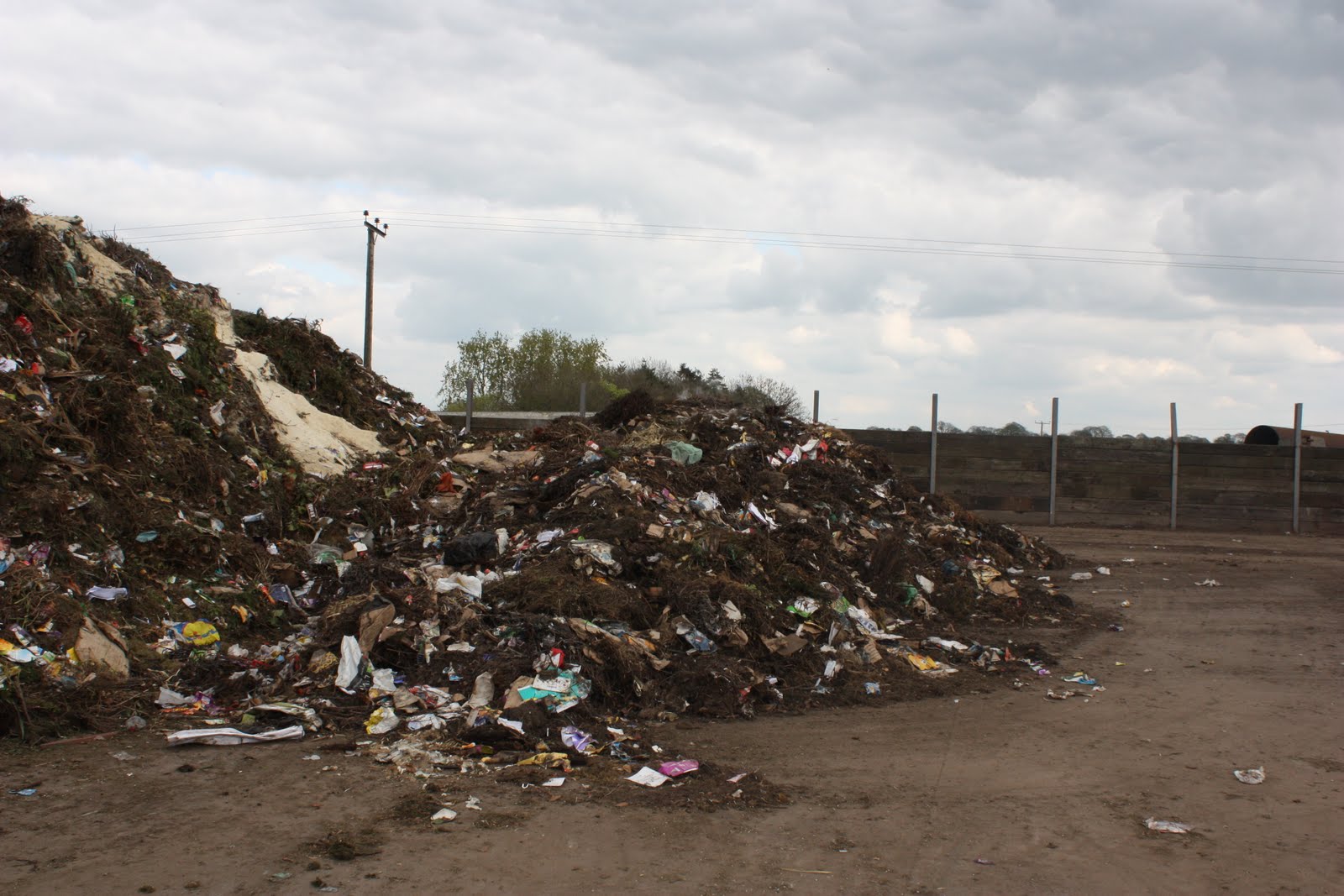
All the waste has to be screened for quality control and it gets hand picked to remove any obvious visible contamination like plastic bags which some idiots seem to think is "compostable garden waste" and insist on regularly adding to their green bins.

The "cleaned" waste then gets loaded into this massive industrial shredder (below) which can shred over 10 tonnes an hour! 


The resulting output which is now much less coarse (generally shredded to about 100mm particle size) then gets piled into huge pyramid shaped mounds called "windrows".  This may look like a messy heap, but theres actually quite alot of intelligent design gone into it because their natural shape aids the air flow through the piles and the natural heat created by the decomposition process helps create convection currents which drive air through the mounds helping to keep the whole operation aerobic.  


The windrows get systematically turned at regular intervals using a JCB.  The piles get extremely hot as they rot, visibly steaming.  The microbial activity which drives this takes place in as little as 2-3 months, far quicker than you would get in a home compost bin.

The finished product, which is certified to PAS100 standard is used on site as a soil conditioner.  Once seived to remove large particles its a fine looking brown earthlike product which is excellent for the soil


For more information on this site visit www.agripost.co.uk